Logo ALLY

FRAUENPORTRAITS GOES

overseas

Stay tuned for ALLY, an inspiring documentary that takes you on a journey above and below the water. Our aim is to inspire and educate about the unjust conditions in Indonesia regarding the sea and gender.
We show you the beauty and the dangers of our coral reef ecosystem and introduce you to female role models who interact with the sea despite stigmatisation of Indonesia society.

Logo ALLY

.

Women, Ocean and Climate Change

new Project

.

About the project

In many tropical and subtropical countries with large ocean areas including Indonesia, women and girls do not swim, snorkel or engage with the ocean as much as men and boys do – 2/3 of women world wide can not swim.

We need to understand that by making it harder for women and girls to choose a career in ocean science we limit the size of the talent pool! What is a shame because our reefs are the ecosystems most rapidly affected by climate change and action is needed – 70 % of the people living in the tropics make their livelihood from our reefs.

With our documentary, we want to raise awareness among potential actors in the West and give Indonesian women and girls the opportunity to raise their voices.
We want to join the fight against climate change in Indonesia by addressing the gender gap and social stigmas in the marine sector.

.

We inspire young women not to be afraid of the sea or the stigma of society

.

Questions we get asked a lot

Well, that’s fine! No one is forced to do anything, we just want to create the opportunity for girls and women to interact with the ocean without the fear of social exclusion. We want to bring girls and women closer to nature on their doorstep because you protect what you love, but to love something you have to be able to experience it in the first place.

We strive for a world where it is the norm for women and girls to swim, snorkel in their home reefs and be part of decision-making processes about the ocean.

Don’t get me wrong. I am not saying that those who are most affected by climate change should be the only ones working against it.
The G20 countries are responsible for 81% of global emissions without being most affected by the consequences. That is not fair! It is also not fair that the top 1.2% of the world’s population owns almost 50% of global wealth. If I could find a way to balance this; to minimise our oversized consumption, to slow down fast living; to stop the oil crisis or to shine in political decisions – I would do it!
But facing reality. It will take too long! Strategies to mitigate the impacts of climate change in affected areas are needed NOW.

The bottom-up approach basically means working from the base of the problem upwards to the cause. The opposite is the top-down strategy.

During my work in humanitarian aid in the Philippines and Nepal, I have experienced how powerful it can be to work from the bottom up, which means being on the ground, talking to people, identifying their needs directly and being able to act and react spontaneously without having to wait for a long decision-making process from the top.
This leads to greater collaboration of the local community, enables creativity and faster risk identification as well as innovation, and makes the problem-solving process more diverse.

A little bit of everything!
We have a rather unique approach where we address the gender gap on ocean issues so that EVERYONE can get involved in marine conservation. The logical way to do this is to pave the way for women and make the ocean freely accessible to them.

To illustrate this, let me tell you a little story:

Imagine there are 100 people living in a small fishing village in Indonesia. On average, half of them are women.The village lives from fishing and the current situation is that women have nothing to do with fishing – that is the men’s business. Consequently, they are not involved in the decision-making processes.

Due to climate change, the temperature of the sea surface is changing. The offshore reefs are dying and with them the biodiversity and the fish catch rate.The fishermen all sit together and think about what they can do now to ensure the survival of the village. They are at a loss.

One woman from the village is interested in nature conservation and has heard about an initiative to reforest reefs. This would be a great solution for the small village, but unfortunately no one listens to her because the social norm dictates that women do not belong in this field. She was already very brave to voice her idea, many women don’t even dare to make a suggestion for fear of not fitting into the image of the good Indonesian woman.

The other women in the village have no real connection to the sea. They have learned nothing about it and do not know what beautiful treasures the coral reef holds. They cannot help the brave women who raised their voices but were not heard, and everything continues as before. The reef is bleaching, many fish are dying and the community is starving because they have no fish left.

If women at least had the opportunity to experience the ocean and see first-hand what climate change is doing to the underwater world, maybe there would be more commitment to protecting it. Then there would be more willingness to break the societal stigmas and women’s voices would become louder.
This would also increase the diversity and pool of ideas for saving the ocean.

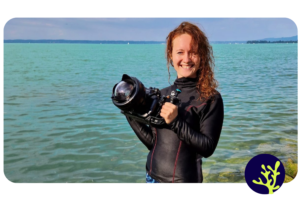
While researching Indonesia’s coral reefs, I found the same statements over and over again, that it does not fit into the image of an Indonesian woman to deal with such issues, that the ocean is reserved for men, that women and girls cannot swim, etc. I was shocked how people can be deprived of the ocean.

The fact that both my professors from Germany and Indonesia and me are all women gave me the idea to film the whole project and show the world that women are VERY successful and important in ocean issues. At first I just wanted to accompany the research project but the idea quickly grew to become a whole documentary about women, the ocean and climate change.
So stay tuned!

Honestly? I can’t.
If you say that the project doesn’t make sense in your eyes because of the long-distance flights,- I can’t say anything against it.
Because we don’t yet know how many people we will reach with the documentation and how many will really change their behaviour as a result. But what we do know for sure is that such projects are necessary.

I believe that it depends on how and why someone flies. Keyword: mindfulness. If I were to jet off to Paris, London, Milan and so on every weekend to go shopping because it’s so cheap, that would be simply stupid. I also find it difficult to fly domestically because of climate change, as it is usually quite unnecessary due to the short distance. Flying is a privilege and we should treat it as such.

At least there a few things we can do to minimize our impact:

  1. Prefer direct flights
  2.  Avoid single-use plastic during the flight
  3.  Choose an environmentally friendly airline (there are some that have a better waste management system than others, and also others that cancel single-use plastic for their flights).
  4. Choose the veggie option on the flight
  5. Travel light to save fuel
  6. Staying on site longer

Frauenportraits is a women empowerment project from Kiel, Germany, to represent local girls and women more strongly. Ally is a daughter approach of Frauenportraits.
Unfortunately, the website Frauenportraits is only available in German (except for the part of the project Ally). We are working on a translation.

Ally means connection. Everything in this world is connected. Every decision you make, has an impact and leaves a print. We have the choice to leave a more beautiful footprint, full of inspiration, compassion and mindfulness towards our planet, choosing love over hate, or to leave a footprint that is deep and dirty, without caring about the suffering our impact may causes in this world.

We connect women to the ocean; we connect girls to role models; we connect climate change to social justice; we connect people from different countries and last but not least we connect you to our vision of a fair and ocean friendly world.

.

The Team

.

Nina

Nina

Nina is the head of the team and the one who had the idea to shoot this documentary alongside her scientific work in Indonesia.
She is a nature, ocean and animal lover and strongly believes that with a good heart, curiosity and commitment you can make this world a better place.

Tanu

Tanu

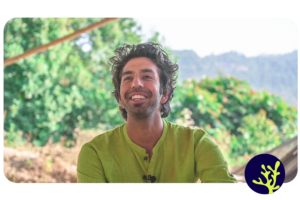
Tanu is not only the best emotional support one can imagine and "rock in the surf", but also responsible for the land shoots. He is a meditation teacher and travel photographer whose goal is to capture the true essence of people and nature and to bring awareness to the world. Nina and Tanu met in Nepal when they both worked as volunteers in the disaster region after the great earthquake of 2015.

Sabrina

Sabrina

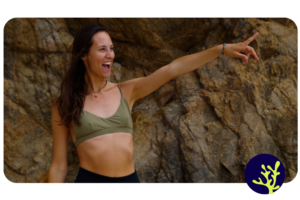
Sabrina is our underwater photographer and drone pilot. She is a dive instructor and has been in love with the ocean since she was little. It didn’t even take her 5 minutes to decide to be part of the project.
Her energy and enthusiasm are contagious and bring buzz to our team.
Besides, Indonesia is her second home and she really knows everyone!